Colosseum History for Kids
A child-friendly history of the Colosseum: who built it, what happened there, gladiators, wild animals, the Underground, the spectators and what remains today.
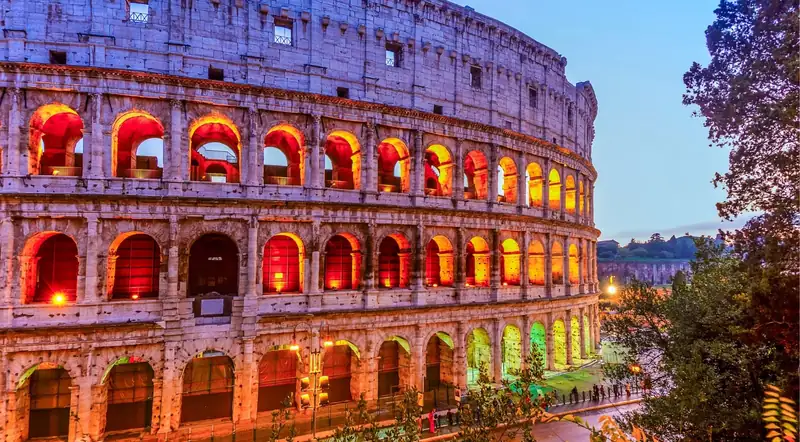
The Colosseum is almost 2,000 years old. The Romans built it as a giant amphitheatre, a stadium where tens of thousands of people came to watch gladiator fights, wild-animal hunts, executions, dramatic performances and elaborate shows with scenery and machinery. They called it the Flavian Amphitheatre; the name Colosseum came later and is linked to a colossal statue that once stood nearby. Much of the original building is gone today: the arena floor has largely disappeared, many seats are missing and parts of the outer wall collapsed or were taken for their stone. Enough survives to show how extraordinary it was. The easiest way to explain it to children: picture a giant Roman stadium with more than 50,000 people in the stands, gladiators in the middle and a whole hidden backstage system under the floor. A family guide who tells these stories on site makes the history stick, and the tour below shows live prices for your dates:
Who built the Colosseum?
Emperors of the Flavian dynasty built the Colosseum, which is why its original name was the Flavian Amphitheatre. Construction began under Emperor Vespasian in the first century AD. His son Titus inaugurated the amphitheatre in AD 80, and the next Flavian emperor, Domitian, kept developing and modifying it.
So if your children ask who built the Colosseum, the simplest answer is: the Flavian emperors, especially Vespasian, Titus and Domitian.
Why did the Romans build it?
Before the Colosseum, this part of Rome belonged to Emperor Nero’s enormous palace complex, and Nero had an artificial lake dug in the valley. After his death the new Flavian dynasty transformed the area. The official Colosseum Archaeological Park describes the change as a symbolic return of one emperor’s private land to the Roman people. The lake disappeared, and a huge public amphitheatre rose in its place.
For Roman emperors, spectacles were more than entertainment. They were also a way to:
- impress the population;
- show imperial power;
- celebrate victories;
- show generosity;
- build a bond between the ruler and the public.
The Colosseum was a stadium and a political statement at the same time.
More Rome experiences for families
Once the children know the story, the rest of Ancient Rome comes alive too, from the Roman Forum and the Pantheon to the Catacombs and the Vatican Museums:
How long did it take to build?
Construction began in the 70s AD and Titus inaugurated the amphitheatre in AD 80, so the main structure went up in less than a decade. Children find that remarkable once they think about what the builders did not have: no engine-powered cranes, no electric drills, no trucks and no computer-designed plans. Roman builders relied on:
- human labour;
- cranes powered by people;
- ropes;
- pulleys;
- stone-working tools;
- careful engineering.
With those, they built the largest amphitheatre in the Roman world.
How big was the Colosseum?
The official Archaeological Park calls the Colosseum the largest amphitheatre in the world, and ancient crowds numbered more than 50,000 spectators. A modern football stadium is the obvious comparison for children. Now imagine tens of thousands of people arriving at once with no electronic tickets, escalators, loudspeakers or digital signs. The Romans still needed a way to get everyone to their seats quickly, so the Colosseum had:
- numbered entrances;
- corridors;
- stairways;
- assigned routes to the seats.
The official park even has evidence of ancient seating tickets that told spectators which entrance and route to use.
Did Romans have tickets?
Yes, in their own way. Spectators used a kind of token or ticket that showed:
- which entrance arch to use;
- which way to go;
- where their seating area was.
That makes the Colosseum easy for children to compare with a modern stadium. You could not walk in and choose any seat; the whole building was carefully organised.
Did everyone get the same seats?
Definitely not. Roman society was strictly ranked, and where you sat showed your social status. The best positions, close to the arena, went to the emperor, the senators and other elite groups; lower-status spectators sat higher up. The Colosseum showed the crowd its entertainment and, at the same time, the social structure of Rome.
Children get this quickly if you compare it with VIP boxes, premium seats and the upper tiers of a stadium. The difference is that in Ancient Rome your social rank decided far more rigidly where you belonged.
What happened inside the Colosseum?
The Colosseum hosted several kinds of spectacle:
- gladiator fights;
- wild-animal hunts;
- public executions;
- staged performances;
- elaborate shows with machinery and scenery.
The Romans called the animal hunts venationes, and the animals could come from distant parts of the empire. The shows were designed to impress. By modern standards they were violent, and they belonged to a culture very different from ours, so say that plainly to children.
Who were gladiators?
Gladiators were trained fighters who performed in Roman arenas. Some were enslaved people, some were prisoners, and others took up the career for different reasons. They trained in specialist schools and fought with different types of armour and weapons.
Near the Colosseum stood the Ludus Magnus, a gladiator training school built under Domitian. The official Archaeological Park says it was the largest and best preserved of the known gladiator barracks linked to the amphitheatre, and it had its own training arena.
Did gladiators live inside the Colosseum?
Not in the way children often imagine. The Colosseum was the performance venue. Gladiators trained and lived in nearby buildings such as the Ludus Magnus (our page on gladiators at the Colosseum tells their story), which a covered passage connected to the Colosseum. A simple way to put it: the Ludus Magnus was the training centre, and the Colosseum was the stadium.
Did every gladiator fight end in death?
No. Films often suggest that every fight ended with one gladiator dying, but the reality was more complicated. Gladiators were trained performers who had cost a lot of time and money to train. Some fights were fatal, but death was not certain in every contest. Tell children this, because the movie image of a gladiator’s life is much simpler than the history.
What was underneath the arena?
One of the most fascinating parts of the Colosseum was hidden from the crowd. Beneath the arena floor lay the hypogeum, usually called the Underground. The official Archaeological Park describes an underground system of roughly half a hectare, with a central passage and 14 visible corridors. It was the backstage area of the Roman show, and it held:
- machinery;
- cages;
- lifts;
- ropes;
- winches;
- scenery;
- workers;
- animals.
The spectators above could not see most of this. You can still look down into it today; our guide to what you see inside the Colosseum explains which ticket shows you what.
How did animals appear in the arena?
This is one of the best Colosseum facts for children. The Romans built lifting systems under the floor. Animals went into cages that were raised using:
- winches;
- ropes;
- platforms;
- trapdoors.
At one stage the Colosseum had 28 animal lifts. According to the official Archaeological Park, running all 28 at once took 224 workers, eight for each winch. Imagine more than 200 people hidden under the arena hauling on the machinery while the crowd above waited for an animal to burst out of the floor. That is why the Colosseum was more than a stadium: it was an ancient special-effects machine.
Was the Underground always there?
Not in the form you see today. When the Colosseum opened in AD 80, the earliest underground installations were largely wooden. Under Domitian the structure was rebuilt in permanent masonry, and over the centuries Roman engineers altered it several times to improve the stage machinery. The building never stood still; it kept changing.
Was there really a floor covering the Underground?
Yes. Roman spectators did not see the maze you see today. A wooden arena floor covered the Underground, and the floor was covered with sand; the Latin word arena is linked to the word for sand. When children look down into the hypogeum now, they are seeing the backstage area only because most of the original performance floor has gone.
Did animals really come from all over the Roman Empire?
Roman spectacles included wild-animal hunts with animals brought from distant regions. The empire stretched across large parts of Europe, North Africa and the Middle East, and bringing exotic animals to Rome showed how far its reach went. For ancient spectators, seeing an unfamiliar animal could be almost as astonishing as the fighting.
Was the Colosseum covered from the sun?
Not by a solid roof. The Romans used a huge awning system called the velarium, and sailors from the Roman fleet helped handle its ropes and canvas. It shaded parts of the audience. For children, compare it with a giant fabric canopy stretched over part of a modern stadium. It is one more sign of how technically ambitious the building was.
How did so many people get in and out?
The Colosseum had a sophisticated system for moving people. Spectators used numbered entrances, stairways, corridors and set routes that led them to their own sections. Modern stadium architects still work on exactly the same problem: how do you move tens of thousands of people safely and quickly? The Romans were solving it nearly 2,000 years ago.
What did people do while waiting?
Roman spectators did not sit in silence between events. Archaeological finds suggest they ate, gambled, played games and chatted through long days of entertainment. The Colosseum Museum displays some of the evidence:
- dice;
- game pieces;
- food remains;
- graffiti.
Ancient spectators got bored, ate snacks and found ways to pass the time, which is one of the easiest details for children to relate to.
Did Romans eat at the Colosseum?
Yes. Finds from the spectator areas include food remains and the vessels it came in. People could spend long periods inside during the games, so food was part of the day. It is another good modern comparison: Roman spectators did much what families do at a stadium today, watching the action, talking and eating.
Why is the Colosseum called the Colosseum?
Its original name was the Flavian Amphitheatre. The name Colosseum is linked to a colossal statue that stood nearby; the statue was connected with Nero and later altered by the emperors who followed. So the building’s famous name was not the formal name the Romans gave it.
Was the Colosseum always a ruin?
No. For centuries it was a working Roman entertainment venue. The official Archaeological Park says spectacles continued until the end of the ancient period, and the last documented event at the amphitheatre dates from the early sixth century. After that, the building took on other uses and stopped being a stadium.
What happened after the Roman games stopped?
The Colosseum had many lives. Over the centuries, parts of it were used for:
- housing;
- workshops;
- storage;
- religious purposes;
- defence.
Families and workers lived and worked in and around the monument in the Middle Ages, and the building became part of medieval Rome instead of an abandoned shell.
Why is so much of it missing?
Several things damaged the Colosseum:
- earthquakes;
- centuries of weather;
- structural collapse;
- stone removal;
- reuse of building materials.
Stone from the Colosseum went into later buildings in Rome, and the official Archaeological Park still preserves marks where huge travertine paving blocks were taken out in the Middle Ages. The Colosseum did not simply fall apart; people also took it apart.
Why didn’t Romans just repair it?
By the time the major damage happened, Rome had changed completely. The gladiator games no longer existed in the same way, the Western Roman Empire had collapsed, and the city had fewer people and different priorities. The giant amphitheatre no longer had its original job, so parts of it became useful as:
- shelter;
- stone;
- workshops;
- fortification.
Were there really naval battles inside?
Ancient writers describe water spectacles in the Colosseum’s early years, before the permanent masonry Underground filled the space beneath the arena. Once that permanent hypogeum was built, flooding the arena on a large scale became much harder. So a statement like “the Romans filled the Colosseum with water all the time” is misleading: mock sea battles probably belong to its first years, and the building changed over time.
Did the Colosseum have special effects?
Yes. Roman stage technology could make animals appear, lift people into the arena, move scenery and push props up through trapdoors. The Underground held the machinery that made these surprises possible, so children can think of the hypogeum as the special-effects department of the Colosseum. There was no electricity and no motors, only:
- ropes;
- pulleys;
- weights;
- human power;
- very clever engineering.
How many people worked behind the scenes?
There is no single number for every day of the Colosseum’s working life, but the lifting machinery alone needed a huge workforce. For the 28-lift system, the official Archaeological Park says 224 workers were needed to run all the lifts at once. That was only one part of the operation. There were also:
- animal handlers;
- performers;
- guards;
- attendants;
- technicians;
- gladiator staff;
- officials.
The crowd saw the show; a large workforce made it happen.
Was the emperor always there?
Emperors attended important spectacles, but not every event needed the emperor sitting there all day. When he was present, he had a very prominent seat. The seating made social status visible, and the emperor’s place reminded everyone that the games were tied to imperial power.
Were the games free?
Roman public spectacles were often paid for by the emperor or by officials as a public gift. For ordinary Romans, the games were an important form of mass entertainment, and that is another reason emperors valued the Colosseum politically. The crowd got its entertainment; the emperor got attention, loyalty and prestige.
How old is the Colosseum today?
The amphitheatre was inaugurated in AD 80, so in 2026 it is 1,946 years since the opening games, nearly 2,000 years. That makes a good question for children: what built in our lifetime do you think will still be standing 1,900 years from now? It helps them grasp the timescale.
Why has it survived for so long?
The Romans built the Colosseum with sophisticated engineering and durable materials. Survival does not mean it stayed untouched, though. The building has been through:
- earthquakes;
- fires;
- stone removal;
- weather;
- structural changes;
- centuries of different uses.
Conservation work is needed all the time to protect what remains. The Colosseum did not stay perfect for 2,000 years, but enough of it survived for us to understand one of the greatest entertainment buildings of Ancient Rome.
How did Romans build such a huge structure?
The Colosseum combined several materials and techniques:
- travertine stone;
- brick;
- concrete;
- tufa;
- vaults;
- arches.
Roman builders were experts at combining these forms. Arches spread the weight, and vaulted corridors held up the seating while letting thousands of people move through the building. The building itself is one of the best lessons in Roman engineering.
Why are there so many arches?
Arches are both practical and structural. They:
- carry weight;
- create entrances;
- create passages for people to move through;
- reduce the amount of solid material needed.
The repeating arches also give the outside its famous look. For children interested in engineering, ask: would a wall with no openings be easier or harder for 50,000 people to get into? The answer explains a lot of the design.
How did the Romans know where to go?
The building had an organised system of routes. Spectators followed a path from a particular entrance arch to their assigned seats, and the ancient evidence includes numbered entrances and seating markers. It is surprisingly modern. A concert or football ticket today might say Gate B, Section 104, Row 12; a Roman spectator also needed to know which entrance to use and where to sit.
Was the Colosseum the only amphitheatre?
No. The Romans built amphitheatres across the empire, and you can still see surviving examples in:
- Verona;
- Pompeii;
- El Jem;
- Nîmes;
- Pula.
The Colosseum was the largest and most famous. It stood in the imperial capital and became the one everyone remembers.
Why is the Colosseum still famous?
Because several stories meet in one building. It stands for:
- Roman engineering;
- imperial politics;
- gladiators;
- mass entertainment;
- violence;
- architecture;
- social rank;
- the rise and fall of ancient institutions;
- centuries of later Roman history.
Children often come for the gladiators and leave understanding much more.
What should kids look for when they visit?
Give children a few missions.
Find the Underground
Can they imagine it hidden under a wooden floor?
Find the spectator levels
Who would have sat close to the arena?
Look at the corridors
How did thousands of people move around?
Look for the arena
Where would the gladiators have stood?
Look at the missing wall
What might have happened to all that stone?
Missions like these turn history into something children look for themselves.
Five facts children usually remember
If they remember nothing else, these five are good ones:
- The Colosseum opened in AD 80.
- More than 50,000 spectators could watch.
- The Underground was hidden beneath a wooden arena floor.
- One ancient lifting system used 28 animal lifts and could require 224 workers.
- Roman spectators had assigned entrances and seating routes.
That is enough to turn the monument from “an old ruin” into something children can picture.
Best ticket if your child loves Colosseum history
If the history is the main draw, we would usually choose one of three formats.
Standard guided tour
Best for first-time, school-age children, because a guide can rebuild the missing parts of the building for them. The Rome for Kids: Colosseum and Roman Forum Tour starts at $125 per person and is rated 4.7/5 from 75 reviews.
Arena-floor tour
Best for children most interested in gladiators, because they stand at the level where the spectacles happened. Our pick is the Colosseum Arena Floor, Roman Forum & Palatine Tour, rated 4.7/5 from more than 2,600 reviews; our arena floor guide compares the options.
Underground tour
Best for older children interested in Roman engineering, because they walk through the backstage structure beneath the arena. Our pick is the Colosseum, Underground, Roman Forum & Palatine Tour, capped at seven people and rated 5.0/5 from 92 reviews; our guide to Colosseum Underground tours with kids has more.
Do children need a guide to understand the history?
No. You can run a very good self-guided visit with a few stories from this page, the free official MyColosseum app and the official Y&Co kids route. A good family guide makes the history much easier, though, because children can ask questions on the spot. For ages roughly 7–12, a guide often adds more than the most expensive access ticket. Our comparison of self-guided and guided Colosseum visits with kids helps you choose.
Quick Colosseum timeline for kids
AD 70s
Vespasian begins building the Flavian Amphitheatre.
AD 80
Titus inaugurates the Colosseum.
AD 81–96
Domitian develops the building further, including major work on the Underground.
Roman imperial period
Gladiator games, animal hunts and other spectacles carry on.
Early sixth century
The ancient spectacles come to an end.
Middle Ages
Parts of the Colosseum become homes, workshops and defensive spaces.
Later centuries
Stone is removed and reused, and earthquakes cause major damage.
Modern era
Archaeologists excavate, study and conserve the monument.
Today
Millions of people know it as one of the great symbols of Ancient Rome.
Frequently asked questions
Who built the Colosseum?
The Colosseum was built under the Flavian emperors: begun under Vespasian, inaugurated under Titus in AD 80 and further developed under Domitian.
Why is it called the Colosseum?
Its formal ancient name was the Flavian Amphitheatre. The later name is linked to a colossal statue that stood nearby.
How old is the Colosseum?
It was inaugurated in AD 80, which makes it almost 2,000 years old.
What was the Colosseum used for?
It hosted gladiator fights, animal hunts, executions and other large public spectacles.
How many people could fit inside?
Ancient audiences numbered more than 50,000 spectators.
Were gladiators kept under the Colosseum?
The Underground was part of the backstage system, but gladiators trained and lived in specialist buildings such as the nearby Ludus Magnus.
What was under the arena floor?
The hypogeum held corridors, machinery, cages, lifts and the backstage structures used to run the spectacles.
How did animals reach the arena?
Cages and platforms were raised with winches, ropes and lifting systems through trapdoors in the arena floor.
Did gladiators always die?
No. Some contests were fatal, but a gladiator fight did not automatically end in death.
Did Romans have tickets?
Yes. Spectators used admission tokens that showed which entrance and route led to their seating area.
Did Romans eat at the Colosseum?
Yes. Archaeological finds include food remains and vessels from the spectator areas.
Was there a roof?
There was no permanent solid roof, but a large awning system called the velarium shaded parts of the audience.
Why is the arena floor gone?
The ancient wooden surface did not survive, so much of the Underground beneath it now lies open.
Why is part of the outside wall missing?
Earthquakes, structural collapse and centuries of stone reuse all contributed to its ruined look.
Are the Underground tunnels still there?
Yes. The hypogeum survives as an archaeological network beneath the arena, and you can visit it with an Underground ticket or a tour that includes it.
The bottom line
The Colosseum was much more than a place where gladiators fought. It was a stadium, a theatre, an engineering machine and a political stage all at once. The Roman crowd saw the show; behind it were gladiator schools, animal handlers, hundreds of workers, lifts, trapdoors, a seating system, numbered entrances and imperial ceremony.
That is what makes the Colosseum such a good historical site for children. They can start with a simple idea, that gladiators fought here, and gradually discover how a whole Roman city organised itself around one enormous spectacle.
If you are visiting with children, teach them a handful of these facts before you arrive. Once they know that the maze below the arena was a hidden backstage, that animals rose through trapdoors and that Roman spectators had assigned entrances like modern stadium crowds, the ruins become much easier to understand. Our guide to visiting the Colosseum with kids covers the practical side, and our pick of the best Colosseum tour for kids compares the family tours. Check your dates in the date picker above, because small family groups fill up first.
Turn the Colosseum Into a Family Adventure
Skip the lines and explore Ancient Rome with a guide who knows how to keep kids engaged — gladiator tales, arena access and hands-on activities the whole family will love. Free cancellation on most tours.
Check Availability & Book