What's Inside the Colosseum? What Families See
What do you see inside the Colosseum? A family guide to the first and second levels, the arena, the Underground, the museum, the viewpoints and what kids notice most.
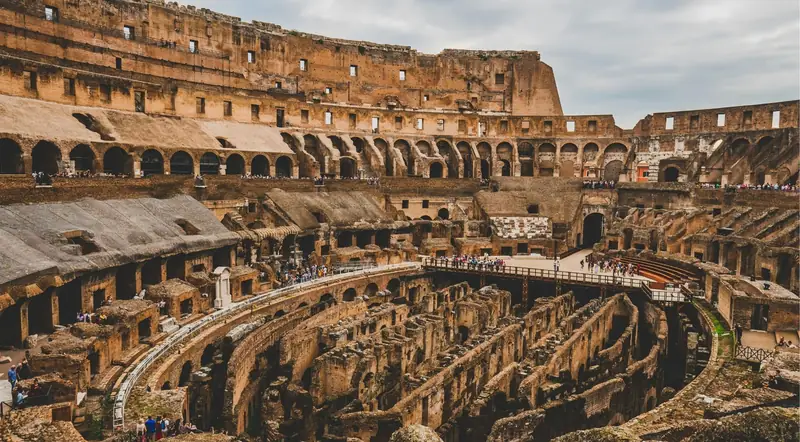
The outside of the Colosseum is instantly recognisable; the inside surprises people. Many first-time visitors expect one giant open arena ringed by seats. You walk into a huge ruined amphitheatre instead, with exposed underground corridors, partial seating levels, stone passageways, a reconstructed section of arena floor, museum displays and views across the whole interior. Children find this exciting and a little confusing: why is there no floor, where did the seats go, and can you walk down into those tunnels? Here is what your family will see once you step inside, and what each ticket adds. A standard ticket already gives you a very good visit: the first and second levels, views down into the exposed Underground and across the arena, the Colosseum Museum and the panoramic terraces. Arena and Underground tickets give you a different angle and restricted access, but a first family visit does not need them. If you would like a family guide to tell the story, the tour below shows live prices for your dates:
What do you see with a standard Colosseum ticket?
The standard official Colosseum, Roman Forum and Palatine ticket includes:
- the first level of the Colosseum;
- the second level;
- the panoramic terraces;
- the Colosseum Museum;
- views down into the Underground;
- views across the arena;
- the Roman Forum;
- Palatine Hill.
It does not include arena-floor access, Underground access or Attic access.
For most families, the standard route still gives an excellent sense of the building. You are not stuck outside looking through arches: you go into the amphitheatre, walk its interior levels and look straight into the centre. Our Colosseum tickets guide for families compares every ticket in detail.
The first thing children notice: the Underground is exposed
The centre of the Colosseum looks almost like a maze today. That maze is the hypogeum, the Underground. Roman spectators saw very little of it, because a wooden arena floor covered the structure below. The floor had trapdoors through which animals, performers, scenery and equipment could appear.
The official archaeological park describes the surviving Underground as covering roughly half a hectare, with 14 visible corridors arranged around a central passage. When children look down into the middle of the Colosseum, they are looking at the backstage machinery of the ancient stadium. It is one of the easiest things to explain before you go.
More Rome experiences for families
Rome has plenty more for children, from the Vatican Museums and the Catacombs to an evening walk past the Trevi Fountain and the Pantheon:
Why is the arena floor missing?
The original arena floor was largely made of wood and covered the Underground. Over the centuries that surface disappeared, which is why most of the hypogeum lies open and you can see the corridors below. Part of the arena has been reconstructed so that visitors with the right ticket can step onto the level where the performances took place. That gives you two different views of the same space.
Standard ticket
You look down towards the arena and the Underground.
Arena ticket
You stand at arena level and look up towards the seating.
Both give you a good view.
What is the first level like?
The first level brings you close to the central structure, and this is where children begin to grasp how large the building is. You can see massive stone arches, circulation corridors, remains of the seating structure, openings towards the arena and the exposed Underground below.
For younger children, this is often enough to make the Colosseum feel real. You do not need to explain every architectural term. Try asking: how would 50,000 people find their seats in a building with no electronic signs? The corridors and arches become interesting straight away.
What happened to all the seats?
The Colosseum had a carefully organised seating system, and Roman spectators could not sit wherever they liked. The official archaeological park explains that seating followed a strict social hierarchy. The best places were closest to the arena: the emperor, senators and equestrians had privileged positions, and people of lower social status sat progressively higher.
Children understand stadium seating immediately, so this topic lands well. Compare it with VIP boxes, premium seats and upper stands; the Roman version was set far more rigidly by social class.
Can you still see original seats?
Most of the ancient seating is gone. The structure of the cavea, the seating bowl, is still easy to read, and the Colosseum Museum explains the seating divisions and shows some surviving inscribed material. Children should not expect rows of intact marble seats; they are looking at the remains of the structure that once held them.
What is on the second level?
The second level gives you a broader view over the whole amphitheatre, and many families get their clearest sense of its shape here. From the upper route you can see the arena, the exposed Underground, the seating levels opposite, the outer structure and views towards Rome.
The official standard ticket specifically includes the second level with its panoramic terraces. That is one reason the standard route still feels complete for families who skip special-access tickets.
Are the best views from the second level?
For many first-time visitors, yes. From the second level you look across the entire monument, not only at the walls immediately around you. It is also one of the easiest places to explain where spectators sat, how the arena fitted inside the building and how the Underground lay beneath the floor. If your child likes taking photos, the second-level viewpoints will probably be a highlight.
What is the Colosseum Museum?
The Colosseum Museum is on the second level. The official park describes it as a permanent exhibition on the monument’s long history. The displays cover:
- spectators;
- seating arrangements;
- inscriptions;
- sculptural decoration;
- the medieval Colosseum;
- later reinterpretations of the monument.
There are multimedia elements too. With children, you do not need to work through it case by case; use it selectively.
Good approach with kids
Stop when a reconstruction explains something they have just seen, a gladiator image catches their eye or an object connects to a story you told.
Less successful approach
Reading every label because admission is included.
Will children like the Museum?
Older children often will; younger ones may prefer the monument itself. Our rough guide by age:
- Under 7: keep the Museum short.
- Ages 7–11: pick a few displays.
- Ages 11+: spend longer if they are interested.
Skip finishing the exhibition; use it to make the building easier to understand.
Can you see gladiator equipment inside?
The Colosseum’s exhibitions and digital material include content on gladiators and spectacles, and the official park publishes plenty on gladiator types, weapons, arena shows, animal hunts and lifting systems. Do not expect the standard visit to feel like a gladiator armour museum, though. The main attraction is still the building. If your child is fascinated by gladiators, an arena ticket or a guided visit adds much more than hunting for objects in display cases.
Can you see the Underground without buying an Underground ticket?
Yes, and this is one of the most useful things for families to know. Standard visitors can look down into the exposed hypogeum from the normal route, and you can clearly see:
- the corridors;
- the pattern of the walls;
- the central passage;
- how the Underground sits below the arena.
What you cannot do is walk through the Underground itself. If your child simply wants to see what is under the Colosseum, standard admission may already satisfy them. If they want to understand the backstage system from inside it, Underground access becomes much more interesting. Our pick on GetYourGuide is the Colosseum, Underground, Roman Forum & Palatine Tour, capped at seven people and rated 5.0/5 from 92 reviews. Our guide to Colosseum Underground tours with kids compares more options.
What do you see on an Underground tour?
Underground visitors enter the restricted hypogeum beneath the arena, which the official park describes as the area where preparations for the performances took place. The surviving system includes:
- corridors;
- the positions of the lifting systems;
- structural spaces;
- areas used for animals and stage machinery;
- the central passage.
Lifting systems could raise animals and scenery through the floor. At one stage there were 28 animal hoists, and running all of them at once took 224 workers. That kind of fact makes the Underground work well for older children.
Does the Underground look like secret tunnels?
Not quite, and it helps to tell children before you book. The Underground is an archaeological structure, not an intact dungeon, a dark adventure cave or a row of complete gladiator cells. Its interest comes from understanding what happened there. A curious 11-year-old can find it fascinating; a six-year-old expecting spooky tunnels may get more from the arena.
What do you see from the arena floor?
The arena floor gives you one of the most dramatic views inside the Colosseum. You stand in the centre and look up at:
- the surrounding seating levels;
- the arches;
- the exposed Underground beside the reconstructed platform;
- the sheer scale of the amphitheatre around you.
For children interested in gladiators, this is often the easiest upgrade to appreciate: they can imagine walking in and seeing the crowd above them. Our pick on GetYourGuide is the Colosseum Arena Floor, Roman Forum & Palatine Tour, rated 4.7/5 from more than 2,600 reviews. Our arena floor guide for families covers every option.
Is the current arena floor original?
No. The ancient wooden floor does not survive, and the section visitors walk on is a reconstruction. It is still worth visiting for the position: you stand at roughly the level where the performances happened and see the building from the performers’ side.
What is the Attic?
The Attic is a higher panoramic route. The official Full Experience Attic ticket includes a panoramic lift, an intermediate gallery, the upper levels and panoramic viewpoints. For first-time families we would put the arena or the Underground ahead of the Attic. For repeat visitors, or teenagers who love views and architecture, the Attic is a good alternative. Our Colosseum ticket prices guide lists what it costs.
Do you see the whole Colosseum from one place?
No. Part of the visit is moving between levels and viewpoints, and the Colosseum changes depending on where you stand:
- First level: you feel close to the arena.
- Second level: the best broad overview.
- Arena: the gladiators’ view.
- Underground: the backstage view.
- Attic: the high panoramic view.
Special-access tickets do not add more things to see. Each one shows the same building from a different position.
Which view is best for kids?
For most children:
- Most exciting: the arena.
- Best overall understanding: the second level.
- Most interesting for older history fans: the Underground.
- Best panoramic experience: the Attic.
For a first visit, the standard second-level route is already very strong.
What parts are included with the standard route?
The standard ticket includes the first level, the second level, the panoramic terraces and the Museum. The arena, the Underground and the Attic each need their own access ticket. So you do not need a premium ticket to get interior views, high viewpoints, a look into the Underground and the museum displays, which matters when you weigh up the extra cost.
Can you see the Roman Forum from the Colosseum?
The upper viewpoints give you wider views across the surrounding ancient city. The Forum and Palatine are separate parts of your ticketed visit, but the Colosseum stands right beside them. Older children can see that the amphitheatre was not an isolated attraction; it sat inside a much larger Roman city. Our guide to the Colosseum, Roman Forum and Palatine Hill with kids covers the rest of the visit.
What should kids look for inside?
Give them a short list. Five things is enough, not twenty.
1. The exposed Underground
Ask: what do you think used to cover it?
2. The arena
Ask: where would the gladiators have stood?
3. The seating levels
Ask: who do you think had the best seats?
4. Entrances and corridors
Ask: how did tens of thousands of people get inside?
5. The view from the second level
Ask: does it look bigger from here or from the arena?
Questions like these get children looking for themselves instead of trailing after the adults.
What is missing from the Colosseum today?
A lot, which is why some children find the first view confusing. Missing or heavily changed parts include:
- most of the original seating;
- the complete arena floor;
- many decorative elements;
- the statues;
- the original upper structures;
- the awnings;
- much of the stone, removed or reused over later centuries.
A guide or a reconstruction helps children put these pieces back in their heads. The Colosseum gets much more interesting once they know what they are trying to imagine; our Colosseum history for kids has the stories to tell them before you go.
Why does part of the outer wall look missing?
The Colosseum has been through earthquakes, structural damage and centuries of stone removal, and material from the monument went into later buildings in Rome. The lopsided outer ring is not how the amphitheatre originally looked. Tell children that it has survived nearly 2,000 years of weather, earthquakes, a changing city and people taking its stone. Its ruined state is part of the story.
Is there anything interactive inside?
The museum uses multimedia displays, and the official park offers free digital tools:
- MyColosseum;
- Y&Co – You and Colosseo.
They add audio, animation, maps and children’s content. If you are visiting independently, download them before you arrive; they make it much easier to explain what is missing from the ruins. Our comparison of self-guided and guided Colosseum visits with kids explains how to use them.
How long does it take to see the inside?
The standard official route allows up to 75 minutes, which is enough for many families. A Full Experience ticket allows up to about 90 minutes inside the Colosseum. Guided tours often take longer overall because they usually continue to the Roman Forum and Palatine Hill. For younger children, we think 60–75 minutes inside the Colosseum itself is a good target. Our Colosseum opening hours guide for families has the times of day that work best.
Do you need all 75 minutes?
No. The official maximum is not a minimum. If your four-year-old has had enough after 45 minutes, leave. You have not failed to “complete” the Colosseum, and a short good visit beats another half hour forced out of a tired child because the ticket allows it.
Are there toilets inside?
The official Colosseum visitor information lists toilets, baby-changing facilities and a Baby Pit Stop. If you are joining a guided tour, use the facilities before the route starts whenever you can.
Is there a lift?
The official site lists lifts, hoists and accessible areas, so the Colosseum itself has good accessibility. The Roman Forum and Palatine are harder going, with uneven surfaces, slopes and ancient paving. If someone in your family has mobility needs, check the exact route before you book.
Can you take a stroller inside?
The Colosseum is easier with a stroller than the Forum. Some routes, group-tour logistics and restricted areas can still make a stroller awkward, and a lightweight one is easier. If you book a tour, confirm its stroller policy instead of assuming the monument’s general accessibility applies to every itinerary. Our guide to visiting the Colosseum with kids covers strollers and baby carriers in more detail.
What will different ages enjoy?
Toddlers
They tend to notice the arches, the open spaces, the people, the views and the size more than the history.
Ages 6–8
They usually respond to gladiators, animals, the arena and the trapdoors.
Ages 9–12
They can start to appreciate the seating hierarchy, the engineering, the Underground systems and Roman entertainment.
Teenagers
They often respond well to the architecture, the engineering, the scale, the social order and the special-access areas.
Standard ticket vs Arena: what changes visually?
With the standard ticket you see the arena from above and the Underground exposed below, and you understand the amphitheatre from the spectators’ side. On the arena you stand in the central space and look up, and the building feels more enclosed and dramatic. For children, the arena has the stronger emotional pull.
Standard ticket vs Underground: what changes visually?
With the standard ticket you look down at the hypogeum and see its overall layout. On the Underground route you walk inside the structure and get a sense of its height, its corridors and where the machinery stood. For older children, this can teach them much more.
Arena vs Underground: what will kids remember?
A useful shorthand:
- Arena: “I stood where the gladiators fought.”
- Underground: “I saw how animals and scenery came up through the floor.”
Both stick. The first is simpler; the second is more technical.
Do you need a guide to understand the inside?
No, but a guide helps because so much of the building is missing. Families have three good options:
- Self-guided: the official ticket plus the free apps, best for flexibility.
- Standard guided: best for school-age children. The Rome for Kids: Colosseum and Roman Forum Tour starts at $125 per person and is rated 4.7/5 from 75 reviews.
- Specialist family tour: best for younger children who need games and storytelling. The Colosseum and Ancient Rome Family Tour for Kids in the date picker above takes three families at most, uses treasure hunts and costs from $251 per person (4.8/5 from 349 reviews).
Pick the self-guided visit if your children are happy to explore with you, and the family tour if they need someone else to hold their attention.
A simple family route through the standard Colosseum
You do not need to stop everywhere.
Stop 1: First interior view
Take in the scale.
Stop 2: Look down into the Underground
Explain the missing floor.
Stop 3: Look across the arena
Talk about the gladiators.
Stop 4: Second level
Explain the seating hierarchy.
Stop 5: Museum
Pick one or two exhibits.
Stop 6: Panoramic terrace
Finish with the big picture.
That gives the visit a clear story without wearing the children out.
Should you visit the Museum before or after explaining the arena?
After. Children understand the exhibits better once they have seen the real space. For example:
- look down into the Underground;
- explain the animal lifts;
- then show them a reconstruction.
That order works better than starting with museum material they cannot yet picture.
Does everyone follow the same route?
Not exactly; your route depends on your ticket.
- Standard ticket: the first and second levels.
- Full Experience Arena: the standard levels plus the arena.
- Underground + Arena: the standard levels plus the Underground and the arena.
- Attic: the upper special-access areas.
Tour operators may also arrange the visit differently, so read the exact inclusions before you book.
What if Arena or Underground closes?
Restricted areas occasionally close for weather, safety or operational reasons. On 12 February 2026, for example, heavy rain closed the Underground and arena areas for the day, while the standard first- and second-level route stayed open. The standard Colosseum is the core of the visit; special access is an upgrade, not the whole monument.
Is it worth going inside if children are young?
Usually, yes. Even if they take in very little history, the physical scale impresses them. Adjust the visit instead. For a preschooler:
- 45–60 minutes;
- simple stories;
- a standard ticket;
- no pressure to carry on to every ruin.
That is enough.
Frequently asked questions
What is actually inside the Colosseum?
Visitors see the first and second levels, the exposed Underground, views over the arena, stone corridors, museum displays and panoramic viewpoints. Special tickets add arena-floor, Underground or Attic access.
Can you see the Underground with a normal ticket?
Yes. Standard visitors can look down into the exposed hypogeum, but cannot walk through it.
Does a standard ticket include the arena floor?
No. Arena-floor access needs a Full Experience ticket or a tour that includes it.
Does the standard ticket include the Museum?
Yes. The Colosseum Museum is included and is on the second level.
Can you see where gladiators fought?
Yes. All visitors can see the arena. Arena tickets let you stand on the reconstructed arena level.
Is the arena floor original?
No. The visitor platform is a reconstruction; the ancient wooden arena floor does not survive.
Are the Underground tunnels intact?
The Underground survives as an archaeological network of corridors and structures. It is not an intact dungeon or cave system.
Can kids walk through the Underground?
Only with an Underground ticket or a tour that includes it.
What is on the second level?
The second level has the panoramic viewpoints and the Colosseum Museum.
How long do you need inside?
Around 60–75 minutes is enough for many families on the standard route.
Are there toilets?
Yes. Official visitor services include toilets, baby-changing facilities and a Baby Pit Stop.
Is there a lift?
Yes. The official site lists lifts, hoists and accessible areas.
What is the best part for children?
For younger school-age children, usually the arena and the gladiator story. For older children, the Underground and the engineering can be more interesting.
Do we need a guide?
No, but a guide can help children rebuild the missing parts of the building in their heads. The official park also offers free digital guides for independent visitors.
The bottom line
The inside of the Colosseum is not one giant preserved Roman stadium. It is a ruin, but an unusually readable one. With a standard ticket your family already gets:
- the first level;
- the second level;
- the panoramic terraces;
- the Museum;
- views into the Underground;
- views over the arena.
That is enough for a very good first visit. The special areas change your viewpoint. On the arena you stand where the action happened; in the Underground you see how it was produced; from the Attic you understand the building from above.
You will see enough with a standard ticket. Choose the viewpoint that will make the Colosseum most interesting to your children. For young kids, the standard route may be all you need. For gladiator fans, add the arena. For older children who want to know how the Roman show machine worked, go Underground. Check your exact dates in the date picker above, because family tours and special-access slots fill up first, and our guide to the best Colosseum tour for kids compares the family options in full.
Turn the Colosseum Into a Family Adventure
Skip the lines and explore Ancient Rome with a guide who knows how to keep kids engaged — gladiator tales, arena access and hands-on activities the whole family will love. Free cancellation on most tours.
Check Availability & Book